Topics: Policy

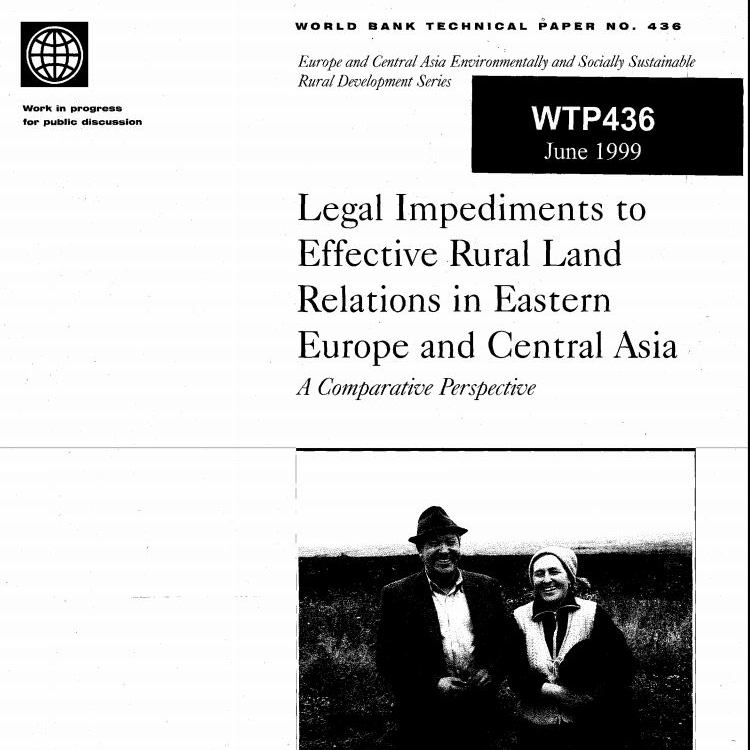
World Bank: Legal Impediments to Effective Rural Land Relations in Eastern Europe and Central Asia

1999

This report by staff from Landesa (then called the Rural Development Institute) discusses land reform and efforts to support the development of land markets in Eastern Europe and Central Asia.  The authors identified countries in which land markets have developed and function well, described characteristics of the legal framework that contribute to the success of land markets in these countries, and developed a “checklist” for use in transition countries to identify obstacles to use in development of land markets. | Download PDF

World Bank Award: Legal Education Center for Farmers’ Land Rights

2008

Description of a Landesa program in China funded by a $198,000 grant from the World Bank to create a Legal Aid and Education Center to provide free and accessible legal education to farmers in rural counties of Guangxi province, and reach out to local area governments and villagers’ committees to increase awareness of farmers’ land rights. Every year more than one million farmers lose their agricultural land due to state expropriations, land readjustments or other forms of compulsory takings in China. Most farmers do not possess basic knowledge about their land rights under the law. The project will be the first of its kind in China, because there are few legal aid services in the countryside, let alone a legal aid center devoted to farmers’ agricultural land rights. | Link to information

World Bank: Chinese Farmers’ Land Rights at the Crossroads – Findings from 2010 Nationwide Survey

2011

A presentation by Landesa staff about a nationwide survey of farming families in China, in which the researchers describe issues relating to documenting land rights, investments in land, an emerging land market, compulsory land takings, and corporate leasing and farming, and offer recommendations.  | Download PDF

Who Owns Carbon in Rural China?

2010

This paper by staff from Landesa (then called the Rural Development Institute) describes the ways in which farmers’ rights to forestland and trees are compromised by historical and institutional factors, and government programs to protect forests. The authors conclude that to ensure the long-term success of such programs while addressing the welfare of the affected rural poor people, China should continue reform efforts, particularly bolstering the security of farmers’ rights over forestland and trees and adequately compensating farmers affected by carbon sequestration programs. | Download PDF

A Case Study on Large-Scale Forestland Acquisition in China

2010

This study by staff from Landesa (then called the Rural Development Institute)  examines the case of one Foreign Direct Investment made by Stora Enso with International Finance Corporation support in forestland plantations in Guangxi, China. The study (conducted between December 2009 and June 2010) finds that despite Stora Enso’s good intentions for Corporate Social Responsibility (CSR), there are major limits to their legal due diligence, which raise risks for local people to both their rights to land and livelihoods. The study points to the continued difficulty of meeting local laws, much less global standards, by foreign investors who hold a commitment to CSR. | Download PDF

Indonesian development and U.S. aid

1987

An overview by Landesa (then called the Rural Development Institute) of the Indonesian development process, current major issues, and a review of the U.S. aid program.  The authors conclude that significant cuts in funding from the U.S. Agency for International Development (AID) are premature and contrary to Congressional mandate, and argue that overall AID funding should be restored to 1979 levels by FY 1990 to lay the groundwork for a new Asian development success story in Indonesia. | Download PDF

Foreign aid: a report card for the proposed FY 1992 program

1991

A report-card evaluation by Landesa (then called the Rural Development Institute) of U.S. foreign economic aid programs — the authors’ 13th report card measuring the effectiveness of such programs in reaching the poor and promoting equitable growth in recipient countries. The authors conclude that the Agency for International Development (AID) is spending only 36 cents on the dollar of the evaluated foreign economic aid on undertakings that are likely to benefit the poor, and that in some less-developed countries, little or nothing of each aid dollar is spent for such effective undertakings. However, they also conclude that AID has a demonstrated capacity to do much better, and that a small number of specific Congressional and Administrative initiatives could significantly improve AID’S performance. | Download PDF

Foreign aid: an assessment of the proposed FY 1991 program

1990

A report-card evaluation by Landesa (then called the Rural Development Institute) of U.S. foreign aid programs — the authors’ 10th report card measuring the effectiveness of such programs in reaching the poor and promoting basic human needs in recipient countries. The authors conclude that the Agency for International Development (AID) is spending only 32 cents on the dollar of the evaluated foreign economic aid on undertakings that are likely to benefit the poor, and that in some less-developed countries, less than 15 cents on the dollar is spent for such effective undertakings. However, they also conclude that in some countries, AID is spending over 80 cents on the dollar on projects to benefit the poor, and that AID needs a larger field staff to implement high-quality projects. | Download PDF

Egyptian development and U.S. aid: a 25-year perspective

1992

Report by Landesa (then called the Rural Development Institute) draws from 14 rounds of fieldwork in Egypt (between 1979 and 1991) to make an independent assessment of the U.S. economic aid program to address the needs of Egypt’s poor majority. The authors include background on the Egypt development process, recent changes, and persisting development issues; a quantitative and qualitative review of the U S aid program; and recommendations on what should be done if U S economic aid resources in Egypt are to help meet critical development needs. | Download PDF

Recommendations for reforming foreign aid

1993

A report by Landesa (then called the Rural Development Institute) providing input as Congress and the President review the U.S. bilateral foreign aid program. The authors discuss why foreign aid should be primarily concerned with poverty alleviation and broad-based sustainable development, and suggest changes needed to transform the bilateral foreign aid program into one primarily concerned with those goals. | Download PDF