




By Christine Anderson, Rusrann Loeng, Juan Robalino, and Sophal Sam
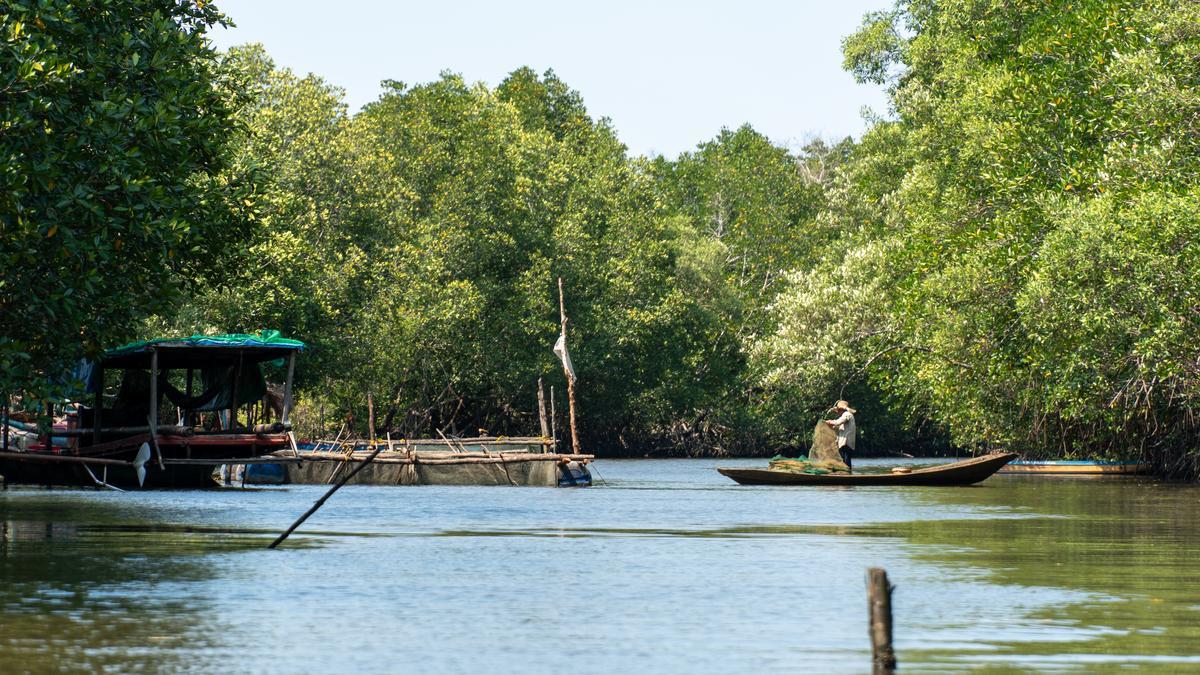
The forests, mangroves, and coastal areas of Cambodia are a valuable source of food and livelihood for millions of rural people. Those same areas also play a critical role in climate action through conservation of biodiversity and the storing of carbon.
In September, the Royal Government of Cambodia took a significant stride in conserving these important resource areas and protecting the rights of its people to access them when it released its Third Nationally Determined Contribution (NDC 3.0) to the United Nations Framework Convention on Climate Change (UNFCCC). This updated NDC raises the country’s climate ambition with a greenhouse gas (GHG) emissions reduction target of 55 percent by 2035, amounting to approximately 73.7 million metric tons of CO2 equivalent.
To achieve this bold target and help Cambodia contribute to the 1.5°C temperature goal under the Paris Agreement required policymakers to explore new strategies. Importantly, Cambodia’s NDC 3.0 recognizes that forest management practices are critical for enhancing carbon stocks and maintaining ecosystem integrity. Crucially, the government of Cambodia highlights the centrality of existing local land tenure arrangements as a mechanism to balance sustainable forest management with the livelihoods of forest-dependent communities. These arrangements include Protected Areas (PAs), Community Protected Areas (CPAs), Community Forests (CFs), and Community Fisheries (CFis).
At Landesa, we are proud to see this recognition explicitly reflected in Cambodia’s NDC 3.0, a milestone that builds on our advocacy efforts over the past year. Our work has emphasized the importance of explicitly recognizing tenurial arrangements in the NDCs as effective tools for natural resource management, particularly in forest and coastal ecosystems. Strengthening community forestry, community protected areas, and community fisheries not only contributes significantly to climate change mitigation but also enhances adaptive capacity at the local level.
To support and advocate for this integration, Landesa carried out targeted assessments of the mitigation and adaptation benefits derived from improved forest management practices under secure tenure systems, focusing on the areas where Landesa’s projects have impact. Such assessments are critical for quantifying their contribution to NDC targets and strengthening evidence-based policymaking. In Cambodia, our advocacy was informed by the development of key resources, including studies on land tenure and climate vulnerability among Cambodia’s CFis.
Case Study 1: Assessing the Mitigation Potential of Strengthening Coastal Community Fisheries’ Tenure
Through this study, Landesa demonstrated that strengthening tenure security and resource co-management in coastal CFis in Cambodia is a strategic approach to conserve and sustainably use coastal and marine ecosystems, directly contributing to the mitigation of climate change. Landesa estimates that mangrove reforestation and avoidance of mangrove forest and seagrass conversion under strong CFi tenure and resource co-management in 8 out of 41 coastal CFis can mitigate approximately 46,506 metric tons of CO2 equivalent in emissions annually.
The findings from this study were presented to Fisheries Administration, Ministry of Environment, and Ministry of Agriculture, Forestry, and Fisheries officials responsible for blue carbon and the NDC prior to the COP29 meeting in 2024. Conservation International Cambodia, an INGO working on blue carbon policies with the Royal Government of Cambodia, included findings from the study in the joint CSO inputs for NDC 3.0.
Case Study 2: Community Fisheries Climate Change Vulnerability Assessment
Through this study, Landesa assessed and presented the climate change vulnerability of five CFis. Drawing on a combination of climate change exposure, key sectoral sensitivities, and limitation in adopting new initiatives as part of their adaptive capacity, the report underscored the high vulnerability of these coastal communities. The findings aligned with broader assessments of climate change impacts in Cambodia’s coastal areas. Consequently, strengthening tenure security, improving resource co-management capacity, and enhancing community awareness of climate risks were identified as crucial steps toward building adaptive strategies and ensuring long-term resilience.
Throughout 2025, Landesa also participated in sub-national and national consultation workshops on NDC 3.0, led by the Ministry of Environment, highlighting the importance of Community Fisheries stewardship as a mitigation and adaptation measure.
These resources have provided the evidence base needed to elevate, together with other stakeholders, the importance of tenure security within Cambodia’s climate strategy. The example of Cambodia sets an important precedent for other countries looking to integrate land tenure and the potential of local community stewardship into their own NDCs.
Authors of this blog include:
- Christine Anderson – Attorney & Sr. Land Tenure Specialist
- Rusrann Loeng – Coastal Tenure Project Lead
- Juan Robalino – Climate Change & Land Tenure Specialist
- Sophal Sam – Cambodia National Coordinator
Related blogs
What can the fortress conservation debate teach us about the importance of women’s land rights in protecting mangrove ecosystems?
Landesa’s new study shows how Indonesia’s new capital can balance urban growth with mangrove conservation by integrating ecosystem service economics into land certification to strengthen gender-responsive land rights.
October 22, 2025
Collective Action as Foundation for Resilience: Securing Women’s Land Rights and Inclusive Governance to Address Climate Change in South Asia
The Women-led Collective Advocacy for Climate Action project built the capacity of networked, women-driven civil society organizations in Bangladesh, Nepal, and Maldives to advance local climate resilience, effective advocacy at all levels of governance, and gender-equitable land rights.
October 15, 2025
Strides for Land, Gender, and Climate through Nepal Policy Reform
Nepal’s updated climate plan highlights the power of land rights—especially for women—as a foundation for equitable climate action.
July 15, 2025
