




By Corey Creedon, Sustainable Livelihoods and Land Use Specialist
Four months out from the 2025 UN Climate Change Conference (COP30), national governments are busy updating their climate action plans.
These Nationally Determined Contributions (NDCs) are the key policy mechanisms through which national governments outline their commitments to address climate change, featuring plans for both reducing greenhouse gas emissions and adapting to the impacts of climate change. Nepal recently finalized its updated NDC, in which policymakers incorporated multiple references to land rights, including the rights of women.
The inclusion of land rights in Nepal’s NDC is a significant milestone for the climate-vulnerable nation in South Asia, with mounting evidence linking stronger land rights—especially for women—with improvements in climate resilience and sustainable land management. Climate-exacerbated disasters can also disproportionately affect populations that are land insecure, further underscoring the importance of incorporating land rights considerations into climate action. Additionally, interventions intended to address climate change, such as renewable energy or carbon offset initiatives, can result in moving people off their land and away from their homes and livelihoods if land rights are not appropriately integrated as a core consideration.
The update to Nepal’s national climate policy comes in the wake of earnest partnership, analysis, collective action, and advocacy from Landesa, the International Land Coalition, and the National Land Rights Forum (NLRF), a Nepal-based partner organization and member of the Stand for Her Land Campaign.
In late 2023, Landesa developed a guide and advisory report, which scanned the prior version of Nepal’s NDC and provided recommendations for enhancing it by better integrating women’s land rights and gender equity. Landesa then supported NLRF to advocate for policy reform that enhanced attention to land rights, women’s land rights, gender equality and social inclusion (GESI), and sustainable land-based approaches to climate action.
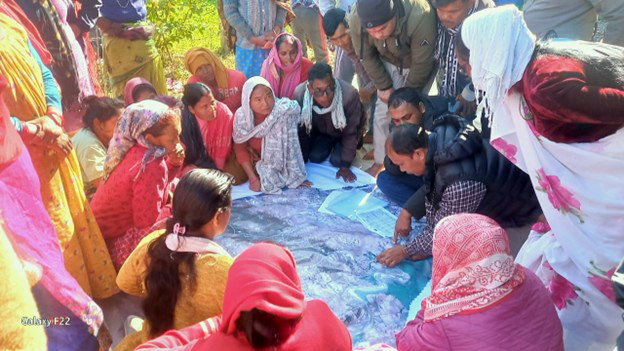
Through the leadership of NLRF, a series of national policy dialogues were held in 2024 which cultivated a space for marginalized civil society voices including women, Dalit, and Indigenous Peoples to exchange with government representatives, such as key officials from Nepal’s Ministry of Forests and the Environment and the Ministry of Land Management, Cooperatives, and Poverty Alleviation. These dialogues focused on the nexus between land rights, gender equity, and climate change, with an eye toward achieving NDC policy reform.
Women’s land rights and equitable climate action
Nepal’s striking geography makes it especially vulnerable to the impacts of climate change. Natural hazards like flooding from glacial lake outbursts amplify existing land issues for landless populations. These impacts are felt disproportionately by women, who hold land rights in fewer than 20% of households across the country.
A growing body of evidence highlights the links between women’s land rights and climate change. Land rights underpin socio-economic relations surrounding natural resource use, decisions around land use, and can cultivate pathways to empowerment, dignity, and opportunity. Securing women’s land rights can help achieve climate mitigation and action through enabling more long-term land investments, an expanded range of response options, and more sustainable management of forest resources. Linkages between women’s land rights, climate action, and sustaining gender-inclusive peace and human security are further underscored in a recently developed Landesa report that features a conceptual model and case studies from South Asia.
Robust climate action reforms

Notably, Nepal’s updated NDC calls to “ensure land use changes are sustainable, and land ownership and rights are strengthened” in the context of land-based climate mitigation efforts. The new version also includes a goal to strengthen forest governance via community-based forest management groups and sustainable forest management. The policy sets a specific target of 50% women representation in key positions for community-based forest management and mandates fair and equitable benefits from sustainable forest management, watershed management, and biodiversity conservation for local communities, women, and Indigenous Peoples.
The updated Nepal NDC further notes that climate change disproportionally affects women, persons with disabilities, Indigenous Peoples, youth, children, and other socio-economically disadvantaged and marginalized groups, exacerbating existing inequalities. A dedicated section of the policy on Gender Equality, Disability and Social Inclusion (GEDSI) includes numerous updates and articulates commitments to strengthening the government’s institutional GEDSI capacity, ensuring the involvement of marginalized and vulnerable groups in climate initiatives, and instituting annual GEDSI audits. Relatedly, the updated NDC features rights- and justice-focused sections on a “Just Transition and Human Rights” and “Loss and Damage.”
Nepal’s updated NDC offers great promise for the nation’s residents and our world’s climate. This process of identifying priority entry points for policy reform and mobilizing inclusive dialogue platforms may serve as a source of inspiration for others interested in advocating for NDC policy reform. Now, quality implementation will be crucial to ensuring equitable climate mitigation and adaptation efforts—with one of the tallest barriers to implementation being funding.
Countries like Nepal—which is among those least responsible for the climate crisis—cannot be expected to carry out their NDCs without international financing support. Wealthier and more heavily emitting nations, international financial institutions, the private sector, philanthropy, the government of Nepal, and civil society must mobilize in partnership to help Nepal deliver on its promises. With sufficient and sustained support, Nepal will be poised to make impactful contributions to mitigating and adapting to climate change and ensuring a sustainable future for its people. By delivering on its commitments, the country can serve as an example for others to follow on climate action, particularly in its mindful integration of land rights, gender equity, and social inclusion.
Categories:
Related blogs
Advancing the Integration of Land Tenure into Nationally Determined Contributions: The Case of Cambodia
Our work has emphasized the importance of explicitly recognizing land rights in the NDCs as effective tools for natural resource management, particularly in forest and coastal ecosystems.
November 06, 2025

What can the fortress conservation debate teach us about the importance of women’s land rights in protecting mangrove ecosystems?
Landesa’s new study shows how Indonesia’s new capital can balance urban growth with mangrove conservation by integrating ecosystem service economics into land certification to strengthen gender-responsive land rights.
October 22, 2025
Collective Action as Foundation for Resilience: Securing Women’s Land Rights and Inclusive Governance to Address Climate Change in South Asia
The Women-led Collective Advocacy for Climate Action project built the capacity of networked, women-driven civil society organizations in Bangladesh, Nepal, and Maldives to advance local climate resilience, effective advocacy at all levels of governance, and gender-equitable land rights.
October 15, 2025
