




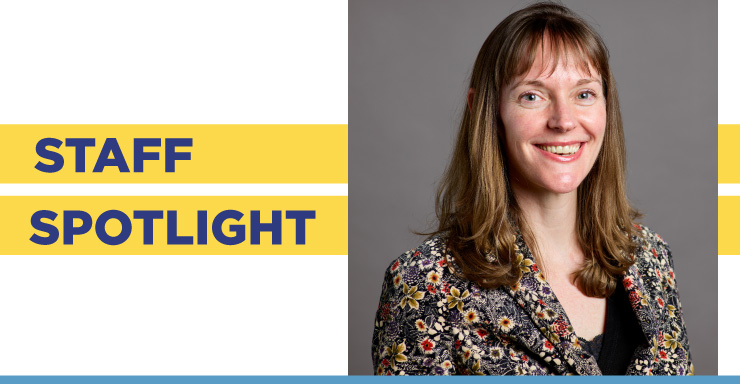
Caitlin Kieran is a Senior Research and Evaluation Specialist based in Seattle. Caitlin started working for Landesa in 2022.
What brought you to Landesa?
I first learned about Landesa (then RDI) in 2009 and attended an RDI event on Women and Land in 2010. I was immediately drawn to Landesa’s mission. While pursuing an MPA in Economic and Political Development and Gender Policy, I worked with Save the Children Ethiopia and the Hunger Project at the intersection of gender and food security. That led me to the International Food Policy Research Institute (IFPRI), where I worked with amazing researchers to study the gender gap in ownership and control of assets, and I became convinced that land is a fundamental source of security — a foundation for food security, nutrition, intrahousehold bargaining power, and economic empowerment. During my Ph.D. in Agricultural and Research Economics, I researched how changes to Ethiopian land laws and Family Codes affected the distribution of assets between spouses, which only deepened that conviction. There is a lot that we still don’t understand about how to realize the promise of land rights, which is exactly why I think this research is some of the most impactful work I can do. Landesa was the natural fit because we conduct research, but we also communicate with policymakers, duty-bearers, and civil society and implement projects on the ground, so there’s a direct line from evidence to impact. When I saw that Landesa was hiring, I jumped at the opportunity because of Landesa’s systems-wide approach and expertise in women’s land rights.
What are your core responsibilities in your role?
As a Sr. Research & Evaluation Specialist on Landesa’s Research, Evaluation, and Learning (REL) team, I help staff and partners design, monitor, and evaluate evidence-based interventions — questioning assumptions, building theories of change, collecting and analyzing data, and reflecting on what we learn from implementation, research, and evaluation. Right now that means serving as REL Representative for the Center for Women’s Land Rights and as the Monitoring, Evaluation, and Learning (MEL) Lead for Stand for Her Land, working with our Kenya team on tenure security and agricultural productivity for smallholder farmers, collecting and reporting organization-wide metrics, and — most recently — supporting a project in Rajasthan exploring women’s land rights as a foundation for addressing gender-based violence.
What is the most rewarding part of your work at Landesa?
One of the most rewarding parts of my work is seeing how evidence improves people’s lives. When I worked with Landesa’s partner Association for Land Reform and Development (ALRD) in Bangladesh, we surveyed women and their husbands about women’s land rights and found something surprising: the barriers weren’t social norms against women applying for khas (public) land, but a lack of procedural knowledge and low self-efficacy. Moreover, norms that restrict women’s mobility and their interactions with men outside their families limited women’s ability to apply for land. ALRD used this to design a more targeted intervention: training paralegals on women’s land rights, encouraging women to visit service providers in groups, and supporting women to speak publicly at meetings with duty-bearers and mass demonstrations. I love reading the stories on the WLR Platform about how those women are now supporting other women in their communities — and seeing real changes in their control over land, wages, and access to agricultural inputs and housing.
How do you spend your time when you’re not working?
I spend most of my free time with my family, including my husband and my two kids (Riley, 5 and Sage, 1). We like to explore Washington’s beautiful parks, playgrounds, and beaches. I also love reading fiction and discussing books with my book club, singing, baking, crafting, and traveling.
Describe your vision for a better world.
I envision a world where a woman’s right to own and control land is never in question — where that is the norm, not the exception. A world where people are tenure secure, food and water secure, and equipped to adapt to and mitigate climate change, and where gender equity and social inclusion aren’t goals we’re still working toward but simply how things are. I believe strong evidence is one of the most powerful tools for getting there: when we can show clearly what works, it becomes harder to ignore or delay progress.
Related news
Informing the African Court: ILP’s Support for Four Amicus Briefs in the Advisory Opinion on Climate Change
International Lawyers Project highlights its legal support for Landesa and RRI’s amicus brief to the African Court on Human and Peoples’ Rights. The submission provides outside expertise to inform the Court’s climate advisory opinion, emphasizing secure land rights for women, Indigenous Peoples and local communities.
October 01, 2026
Press Release: RRI and Landesa Urge African Court to Strengthen Community Land Rights Protections, especially for women, as a Climate Obligation
A joint amicus brief calls on the African Court on Human and Peoples’ Rights to recognize Indigenous Peoples and local communities, especially women, as rightsholders under the African Charter, and affirm their secure land rights as integral to climate action.
September 16, 2026
Staff Spotlight: Ralph B. Quiah
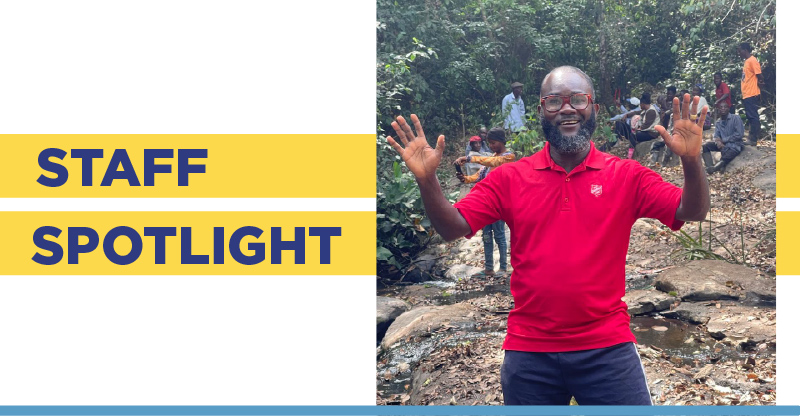
Meet Ralph B. Quiah, GIS and Mapping Specialist based in Liberia. Ralph started working for Landesa in 2020.
September 16, 2026
