




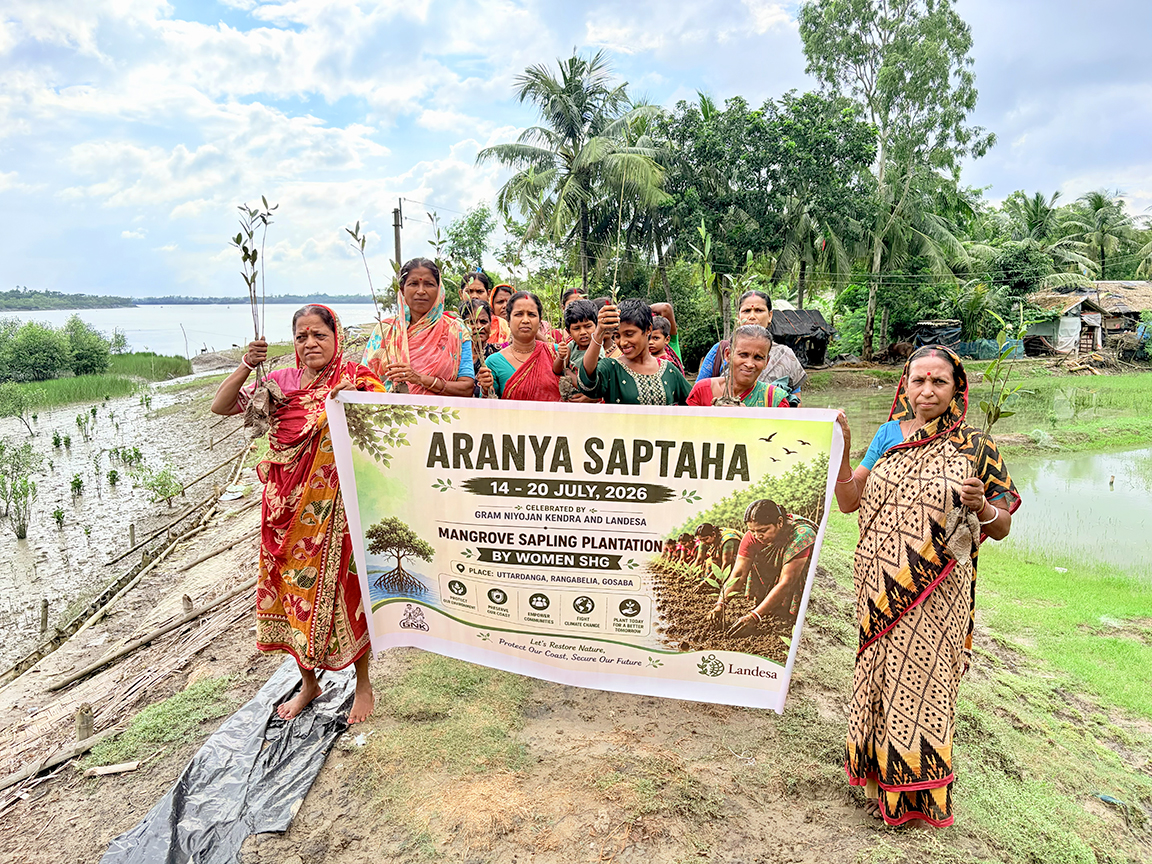
A late-arriving monsoon has delayed the sowing season in Gosaba, one of the main delta islands in the Indian Sundarbans in the state of West Bengal.
However, the momentum around replanting and restoring the area’s mangrove forests has continued without delay. Beginning July 14, women self-help group (SHG) members from Rangabelia village gathered at the local Sangha office to celebrate West Bengal’s Aranya Saptaha, or Forest Week.
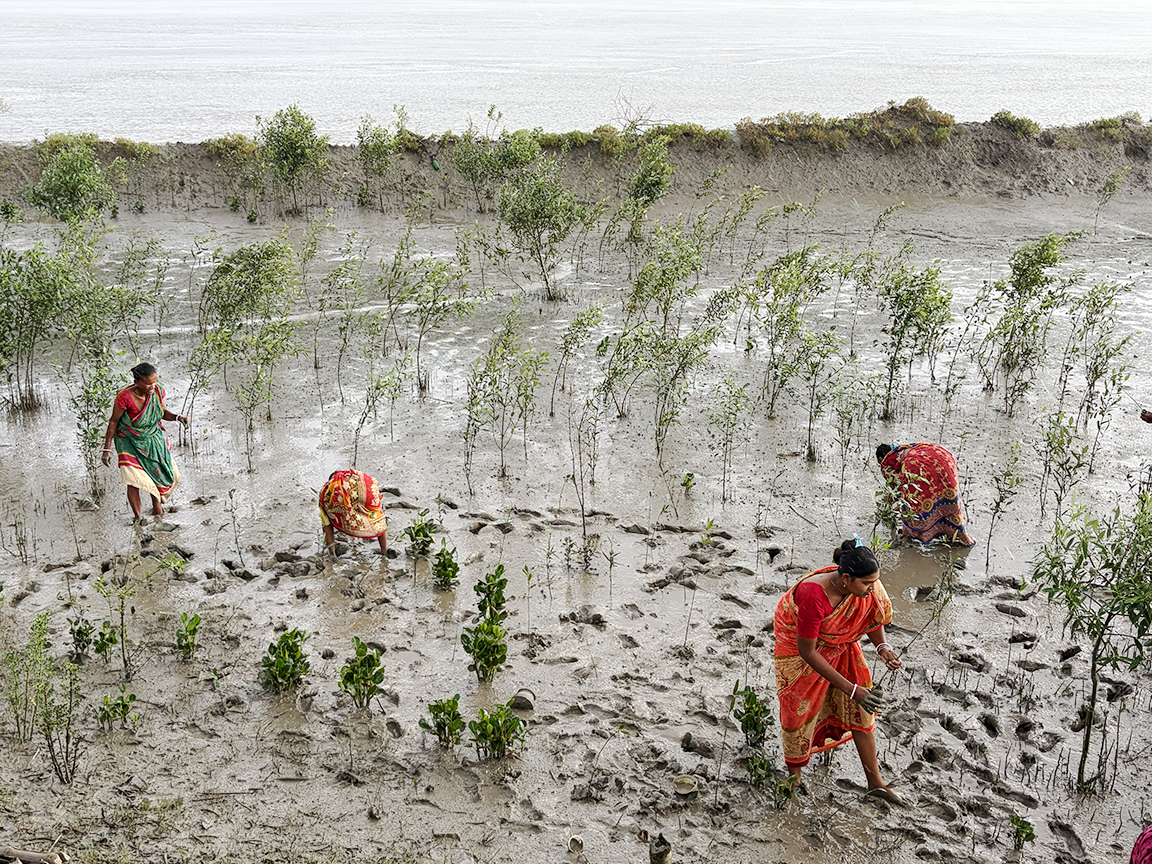
Eighteen women SHG members, each holding a mangrove sapling in hand, walked in a procession along the riverbank to mark the onset of Aranya Saptaha. The women raised slogans on mangroves conservation while walking through local hamlets before assembling on a mudflat where they would plant their saplings. Undeterred by a sudden rain shower, the women planted 50 saplings, reaffirming their commitment to protecting the fragile ecosystem they call home. The saplings are procured from a fellow SHG member who keeps a mangroves nursery to make a living.
“Last year we purchased 1,300 saplings, and planted those to celebrate World Mangroves Day, falling on 26 July,” began Promila Mondal, secretary of Rangabelia Sangha and a distinguished leader among the area SHGs. “To ensure planted saplings survived, we erect fencing around the plantation site to guard the young plants from straying cattle and goats.”
Of last year’s saplings, Promila estimates that 80 percent have survived, thanks to the community’s preventive measures.
This is the fourth year that women in Rangabelia have organized rallies and planted mangroves to promote awareness on the importance of protecting these ecosystems. Importantly, over the years, the work has evolved from an annual event into a shared community responsibility.
But this transformation did not happen overnight. Situated in one of the most climate-vulnerable regions of the world, the people of Rangabelia have always depended on mangrove forests. For generations, families have relied on rivers and mangroves for fishing, crab collection, firewood, and other forest resources that support their daily survival.
However, increasing human dependence and overuse of mangrove resources gradually reduced forest cover in many areas. As this protective green belt weakened, the impacts of cyclones, flooding, riverbank erosion, and saline water intrusion became more severe, threatening both livelihoods and biodiversity.
While people experienced these hardships every year, they had limited understanding of the cause, or of how closely their own lives were connected to the health of the mangrove ecosystem.
Recognizing this challenge, in 2022 Landesa launched an initiative on climate change impact mitigation through mangrove conservation, and selected Rangabelia as one of the pilot areas. The initiative began with consultations and sensitisation at the Sangha level before expanding to implementation by the area’s SHGs.
In Rangabelia, the Sangha selected Lipika Mondal to facilitate this women-led community action. Today, as Sangha president, Lipika continues to champion the initiative by facilitating awareness sessions, mobilizing women, and leading conservation activities. Reflecting on the early days, Lipika recalls that women could clearly describe the challenges they faced, but rarely understood their underlying causes.
“We knew that cyclones were growing more intense, that weakened embankments were being breached, and that severe flooding was imminent, but we did not know the reason,” Lipika explained. “Through the awareness sessions, we learned how climate change affects our lives, and how mangroves protect us. We now understand that mangroves absorb large amounts of carbon dioxide, act as a natural barrier during cyclones, and help reduce flooding.
“Once women understood this, they started changing their own behavior.”
Since the start of the project, more than 500 SHG women in Rangabelia have participated in sensitization sessions facilitated by Lipika. Most are fisherfolk who regularly depend on rivers and mangrove ecosystems for their livelihoods. The discussions encouraged them to reflect on their own practices and explore ways to reduce pressure on mangrove resources while protecting their household incomes.
“Earlier, people often cut mangrove branches and allowed cattle to graze in mangrove areas without realizing the consequences,” Lipika said. “Today, these practices have reduced significantly. Women remind each other that protecting mangroves means protecting our own villages and our future.”
Understanding that conservation efforts must be paired with efforts to strengthen livelihoods, in 2025, Landesa organized trainings on climate-smart alternative livelihoods. More than 500 women across numerous SHGs in the Sundarbans have benefited from the trainings, which teach participants about inland aquaculture, climate-smart farming, and how to access credit. By applying what they’ve learned, women are able reduce their dependence on mangroves while improving household income.
Promila, the Sangha secretary, reiterates that conservation and sustainable livelihoods must go hand in hand.
“Planting trees has always been part of our tradition, but in the Sundarbans, protecting biodiversity also means reducing overdependence on mangrove resources,” she said. “Climate-resilient livelihood practices help families earn sustainably while allowing mangroves to regenerate.”
Today, the women of Rangabelia Sangha are not merely participants in conservation activities — they are leaders driving change within their communities. What began as an awareness initiative has evolved into a community-led collective action. The women who once struggled to understand why their environment was changing are now powerful custodians of nature.
Related blogs
Climate Action in Africa Must Protect Community and Women’s Land Rights
For communities across Africa, a land deed means a stronger voice in decisions about its territories and natural resources. Landesa and RRI are urging the African Court on Human and Peoples’ Rights to affirm that climate efforts must respect the land rights of communities and women across Africa.
September 22, 2026
A People-Centered Solution to Conserve Mangroves and Foster Resilient Communities
A 20-year analysis of mangrove forest cover dynamics in Thailand found that mangrove ecosystems fared better when under community management.
July 21, 2026
Before the Dispute: How Land-Based Investments Can Shape Conflict Long Before It Appears
Land-based investment can generate or intensify conflict — but it doesn't have to. Investment processes that respect community rights, assess risks early, and ensure meaningful consultation and consent are more likely to result in outcomes that work for communities and investors alike.
June 26, 2026
