




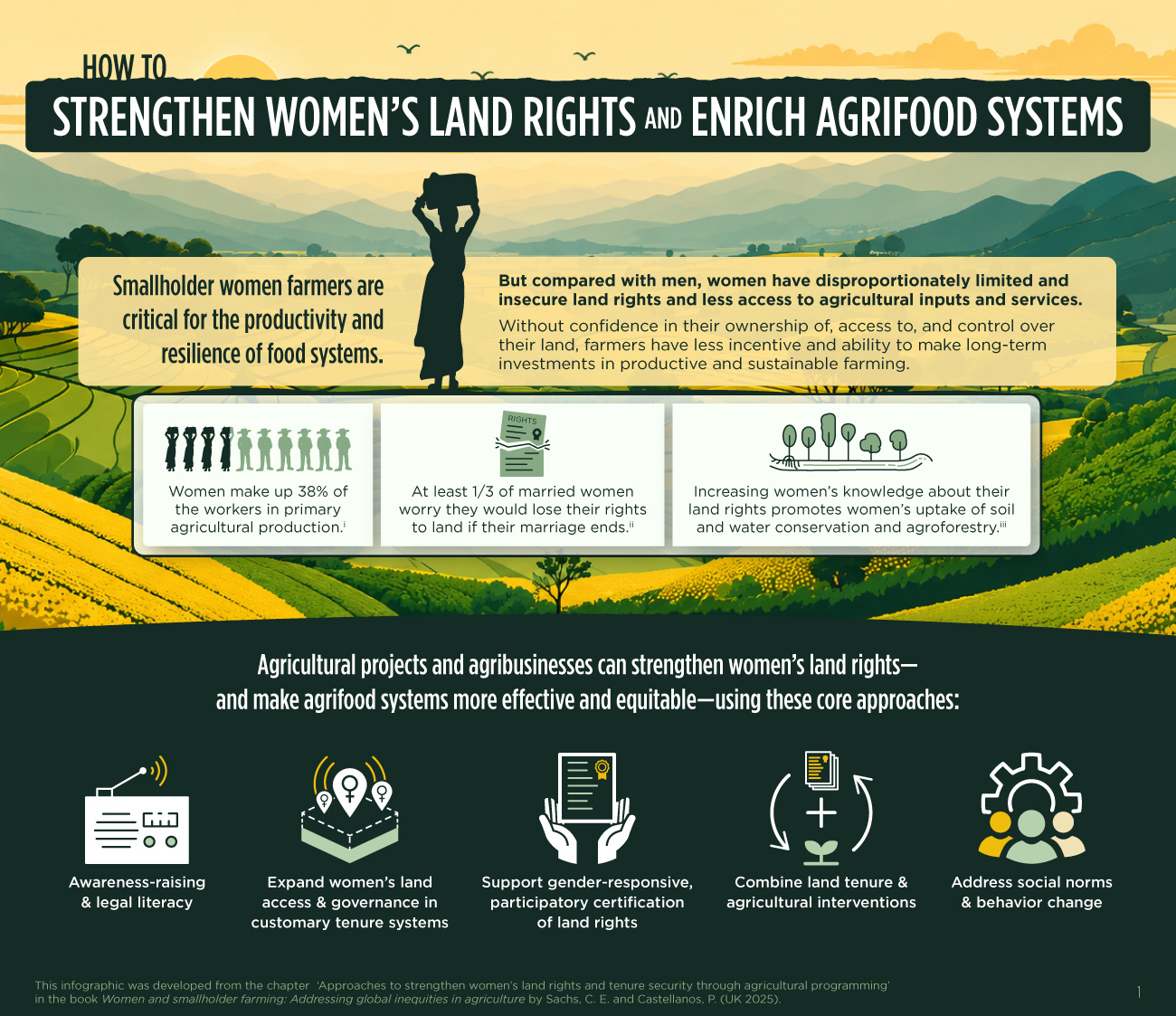
Although women are 38% of the workers in primary agricultural production, smallholder women farmers have disproportionately limited and insecure land rights and less access to agricultural inputs and services (FAO, 2023). Without confidence that in the long-term they can farm a given parcel of land, make decisions about it, and control earnings from it, all farmers have less incentive and ability to invest in productive and sustainable practices.
We know that women farmers with stronger land tenure are more likely to invest in long-term income and the health of their land through practices like fallowing, planting trees, and making channels to manage water. Easing both land tenure constraints and agricultural constraints are essential for advancing agricultural economies, food security, women’s empowerment, and effective and inclusive food systems.
It can, however, be challenging for agricultural development projects or agribusinesses to know what steps to take to strengthen women’s land rights. Landesa’s chapter “Approaches to strengthen women’s land rights and tenure security through agricultural programming” in the recently published Women and smallholder farming: Addressing global inequities in agriculture draws from twenty development projects, government programs, and private sector examples to highlight five tested approaches that agricultural projects and companies can apply to increase women’s access to land or improve the security of their land rights.
- Awareness-raising and legal literacy efforts ranged from adding a women’s land rights session in farmer group trainings to radio programs with messaging around land. Successful approaches allowed people to have multiple, iterative interactions with content and messages.
- Expanding women’s land access and governance roles in customary tenure systems involved making the benefits of women having secure access to land and participating in customary land governance visible to communities and traditional leaders (mostly men) and showing how those benefits align with community values. Dialogues with traditional leaders, training for women and men in land governance bodies, and granting women’s groups access to land all built community support for women to have secure rights to land and began to shift beliefs that women could capably manage land as farmers and local leaders.
- Addressing social norms helped build support for women’s land rights in communities. Approaches engaged men and local leaders, identified and supported local champions, and created opportunities for communities to develop their own solutions. The Securing Your Family’s Future Project in Kenya, Tanzania, and Uganda created opportunities for men to build positive norms together to encourage specific behaviors as fathers and husbands that support women’s land rights. Household dialogues, dialogues among leaders, and trainings created opportunities for people to reflect on existing norms and discuss advantages of inclusive land rights. Some traditional leaders in Zambia even updated community by-laws to protect women’s land rights and encouraged men to follow their example in adding their wives to land documents.
- Combining land and agricultural interventions in the same project can better address farmers’ multiple needs. Seeing secure land tenure and access to agricultural inputs as a necessary combination to build farmers’ sustainable productivity and restore depleted soils, NCBA CLUSA’s PROMAC II Project in Mozambique directly provided both land certificates and agricultural inputs to project farmers. Preliminary findings suggest that certificates increased demand for agricultural inputs and willingness to make agricultural investments only among women farmers – who may have initially been less tenure secure. In India, PepsiCo and USAID combined agronomic training for women farmers with developing group land leases, enabling women to access land and join PepsiCo’s potato supply chain through self-help groups. Land projects also linked farmers who received small plots or land certificates with local microfinance institutions and agricultural projects. The level of effort of the linkages ranged from informal communication between projects to working with microfinance institutions to create a new loan product for farmers with land certificates.
- Helping farmers get land certificates, from the government or cooperatives, was a strategy agribusiness and projects used to reduce risk and disputes in their supplier base and to increase farmers’ use of inputs and practices to improve their land’s productivity. Efforts emphasized joint certification between wives and husbands, making sure both were present at key steps and that both received certificates. Activities promoted social acceptance for wives to be named on certificates as rightsholders, often by appealing to goals for family prosperity and responsibilities to care for children and widows.
These approaches are also explored in a new infographic, How to Strengthen Women’s Land Rights and Enrich Agrifood Systems – Landesa, which was developed from Landesa’s chapter.
Several lessons emerged across the examples about how to apply the approaches:
- Include men, especially traditional leaders, regardless of the approach. Women farmers’ access to land, access to inputs and resources to cultivate land, and power to spend agricultural earnings are often greatly dependent on their male relatives and (mostly male) leaders.
- Collaboration among land experts, agricultural experts, and gender experts helps clarify how existing tenure systems and gender norms affect women and men farmers’ opportunities and choices to engage with the project. It also helps in identifying entry points and designing activities to more fully address women farmers’ needs.
- Combine multiple approaches as feasible for the farmers’ and for the project’s resources. Most examples applied awareness-raising with another approach.
- Awareness-raising and norm-change activities need to be tailored, iterative, and locally led. Successful efforts lasted several months, had multiple in-person interactions to build trust, created opportunities for people to practice and reflect on new ideas and behaviors, focused on influencing a core group of people before pursuing widespread reach, and were guided by staff from the local area.
- Inclusive and equitable land certification requires intentional effort – and ideally dedicated staffing and sensitizing project staff – to involve women and men in all certification steps and build communities’ support for women having their names on land certifications and using the rights that come with it.
Spanning large and small projects and a variety of cultural and agricultural contexts, these examples demonstrate that projects and companies can address underlying gendered land tenure issues in contextually relevant ways. By thoughtfully adopting these approaches, we can increase women’s access to land and tenure security and increase women farmers’ use of agricultural inputs, use of good agricultural practices, and participation in commercial agriculture – creating positive outcomes for women, families and communities.
We encourage communities, agricultural projects, and agribusinesses to use lessons from the chapter and share their own examples – with each other, governments, and funders – of how and why they are working to strengthen women farmers’ land tenure.
Related blogs

Climate Action in Africa Must Protect Community and Women’s Land Rights
For communities across Africa, a land deed means a stronger voice in decisions about its territories and natural resources. Landesa and RRI are urging the African Court on Human and Peoples’ Rights to affirm that climate efforts must respect the land rights of communities and women across Africa.
September 22, 2026
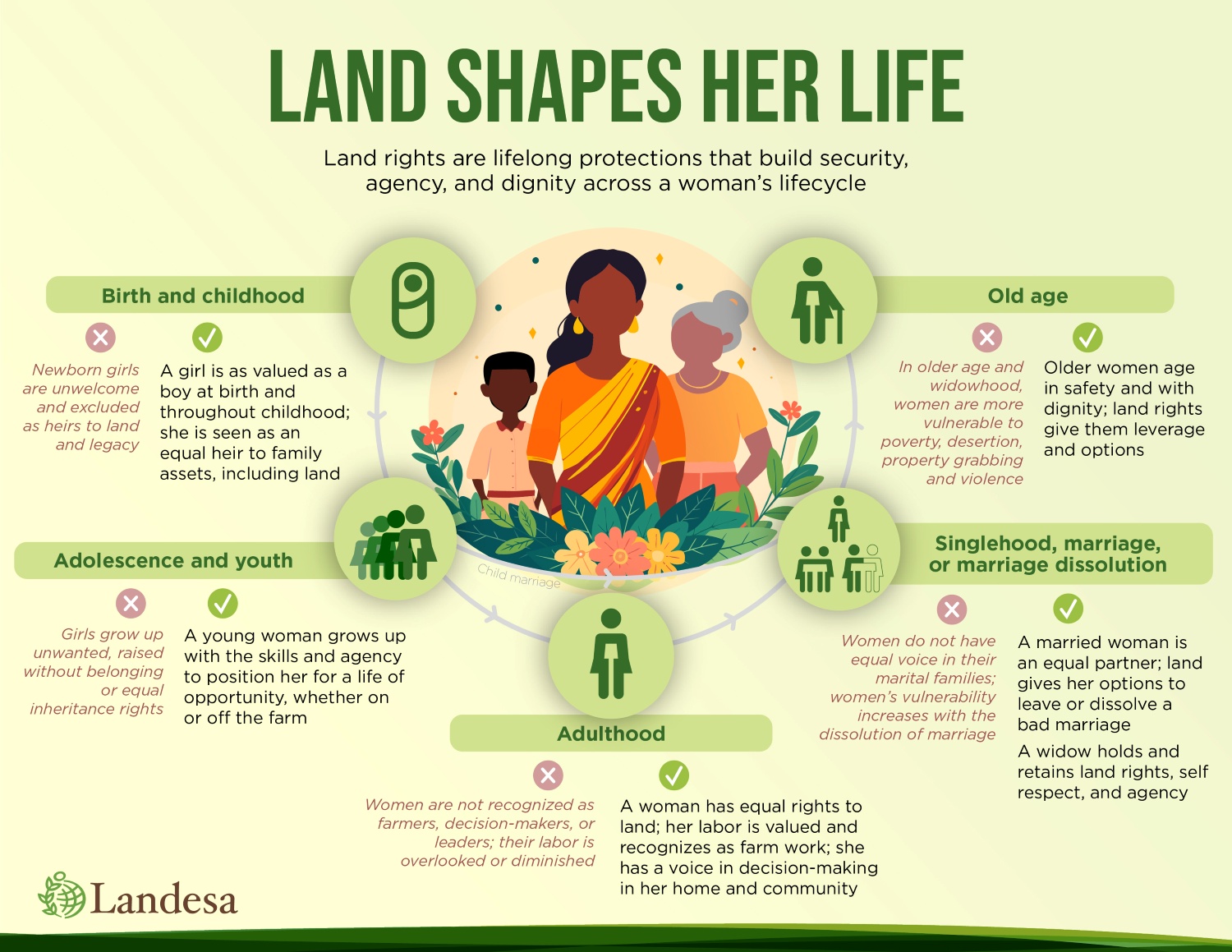
Tilling without Title: Why Millions of Women are Left Out as Farmers
Women make up nearly half of the agricultural workforce worldwide, but without secure land rights, they remain excluded from resources, decision-making, and recognition. A lifecycle approach reveals how these inequalities take root early—and how strengthening women’s land rights can transform lives and livelihoods.
April 23, 2026
Stories of Hope and Resilience for International Women’s Day
Women help feed the world. To honor them, let’s secure their rights to land. Globally, more than 400 million women work as farmers, growing…
March 08, 2026
