
Macro-impact of Micro-plots

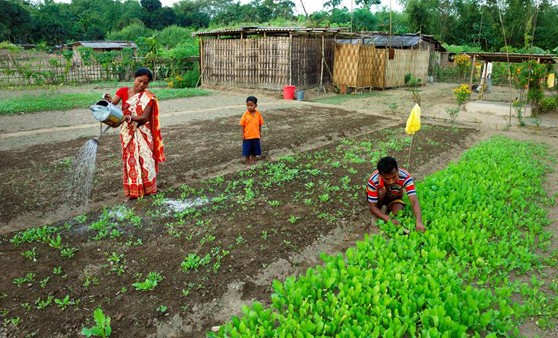
A micro-plot in Dorko Village of West Bengal, India

From the Philippines to South Africa, developing countries are pouring huge resources into providing housing for their poorest citizens.

This is a valiant effort and should be applauded.

But it can also be improved upon.

Using an innovation that is rather simple and affordable.

There is an extensive body of research that shows that providing the poor with not only housing but also a small plot of land surrounding their new home dramatically boosts the impact of such poverty alleviation programs.

Here’s how: by providing families with a home on a small plot of land, about the size of a tennis court, governments can provide not only the security of a home and bargaining leverage in labor markets, but also a place to grow vegetables and fruit, enhanced nutrition, a place to start a home business, and a place to store inventory or keep livestock. Landesa helped pioneer this micro-plot model.

Home garden plots also have the added benefit that they can provide women with significant control over household assets. Sale of micro-plot produce is often one of the only sources of independent income for women in the developing world. And it is often one of the few ways for them to ensure that their children’s nutritional needs are met.

The small plots of land necessary for such an improvement don’t require dramatic rethinking of current programs. And they don’t require so much land as to be physically or economically unfeasible.

India has had great success with its micro-plot program and thus far almost half a million families have benefited from programs in states from Odisha to West Bengal.

In Russia, in the 1970s and 1980s about two to three percent of all arable land was held in small “household auxiliary plots” or on “dacha plots” and produced 25 to 30 percent of the total value of agricultural production.  Today, these small private plots (now fully privately owned) occupy about five percent of arable land, and produce  more than 50 percent of the total value of agricultural production.

Studies have found this to be the case from South Africa to Russia and China to Bangladesh – small plots produce big returns.

Roy Prosterman

About Roy Prosterman

Roy Prosterman, Founder and Chair Emeritus of the Rural Development Institute (RDI), and Professor Emeritus of Law at the University of Washington, is a pioneering world expert on democratic land reform, rural development, and foreign aid. He has provided advice and conducted research in more than 40 countries in Asia, the former Soviet Union, Europe, the Middle East, and Latin America. Professor Prosterman has received numerous awards and distinctions, including having been twice a nominee for the Nobel Peace Prize, receipt of the 2003 Gleitsman International Activist Award, recognition as an Outstanding Global Social Entrepreneur by the Schwab Foundation for Social Entrepreneurship, and received the inaugural Henry R. Kravis Prize in Leadership where he was described as “champion for the world’s poor” in 2006. Most recently, he was named World Citizen of the Year by the World Affairs Council in 2008. Prosterman’s expertise on land rights, foreign aid, and development policy is reflected in his numerous publications and in his access to and relationships with senior developing country officials around the world. Professor Prosterman has a B.A. from the University of Chicago (1954) and a J.D. from Harvard Law School (1958). Forty years ago, he left a rising career with one of the nation’s top law firms, Sullivan & Cromwell, for a teaching post at the University of Washington School of Law. Led by a passion for addressing global poverty, he has devoted his career to applying the law to build a better world.
This entry was posted in Economic Development, Land Rights and tagged , , . Bookmark the permalink.

2 Responses to Macro-impact of Micro-plots

  1. Godfrey Massay says:

    Thank you for this Prof Roy.

  2. Pingback: What a Little Land Can Do - NYTimes.com

Leave a Reply

Your email address will not be published. Required fields are marked *

You may use these HTML tags and attributes: <a href="" title=""> <abbr title=""> <acronym title=""> <b> <blockquote cite=""> <cite> <code> <del datetime=""> <em> <i> <q cite=""> <strike> <strong>

From Our Blog

Sanjoy Patnaik

A Priceless Asset for India’s Women

This article was originally posted by the Wall Street Journal on their India Real Time blog on April 19, 2013. The Indian constitution says women are equal to men, and the country prides itself on gender-sensitive legislation. But even its progressive laws …
Read More

Landesa

Show Me Your Palms, Sister

By Swati Bhattacharjee – a chief reporter-district for the Bengali newspaper “Ananda Bazar Patrika.” This is an excerpt from her original article which was published as an Op-ed in Bengali on 14th April. Two women in West Bengal, India broke a …
Read More

Jen Duncan

Celebrating International Women’s Day: Inspiration from Kenya

My name is Jen Duncan and I’m a senior attorney at Landesa. People often ask me, “I think I understand land rights but what exactly do you guys do at Landesa?”The words that I’m about to share will  hopefully  provide …
Read More

On Twitter